An Introduction to Lenormand Cards
What are Lenormand Cards?
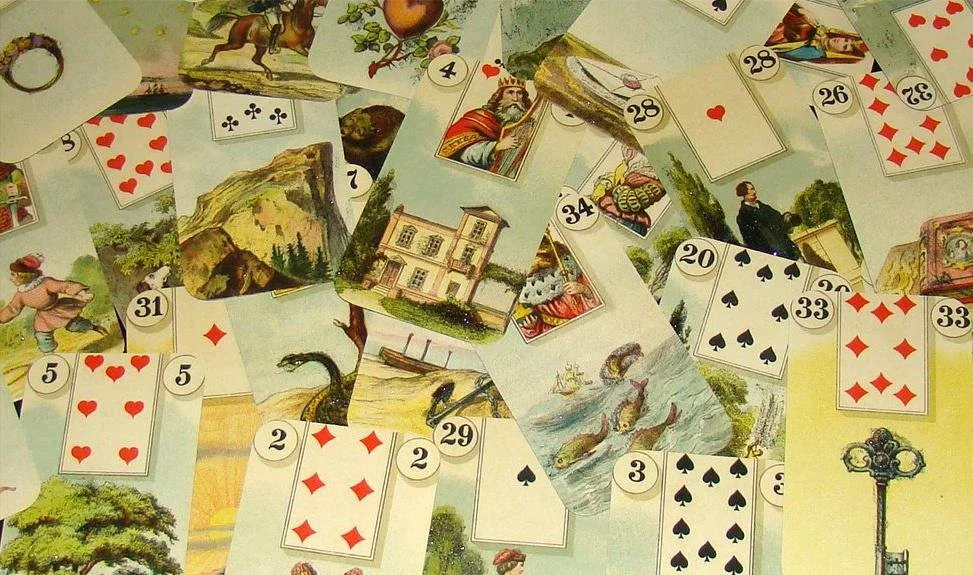
The Mademoiselle Lenormand cards are a type of fortune-telling deck that traces its roots back to the early 19th century. Named after Marie Anne Adelaide Lenormand (1772–1843), one of France's most famous and influential clairvoyants, these cards became a popular tool for divination during her lifetime.
Lenormand was renowned for her accurate readings, which she performed for high-profile figures, including Napoleon Bonaparte and Empress Josephine. Her fame grew, and soon she was known as the "seer of Paris", with a reputation for revealing both the present and future through her readings. Her success contributed to the growing interest in cartomancy during the French Revolution and the subsequent rise of occultism across Europe.
Though Lenormand herself did not create the deck that bears her name, a series of 36 cards came to be associated with her and were later marketed as "Le Petit Lenormand". These cards featured symbols that were inspired by playing cards, astrology, and the traditional tarot but were more compact and straightforward. The Lenormand deck differs significantly from tarot in structure and interpretation, focusing on simple, direct symbols—such as the heart, clouds, whip, and anchor—to tell the story of a person’s life and future.
After Lenormand's death, her name became synonymous with the deck, and it gained popularity in both France and Germany throughout the 19th century. While Tarot decks remained the most popular tool for divination, Lenormand cards carved out a niche due to their accessibility and simplicity. They are often seen as a more practical and less complex alternative to Tarot readings.
Today, the Lenormand deck remains widely used by practitioners of cartomancy and has undergone numerous reinterpretations and modern designs. It is especially favored for its straightforward and precise readings, typically providing concise answers to specific questions.
In essence, the Mademoiselle Lenormand cards represent a blend of history, mysticism, and practicality—a tool that has withstood the test of time, continuing to be a source of intrigue for fortune-tellers and enthusiasts alike.